
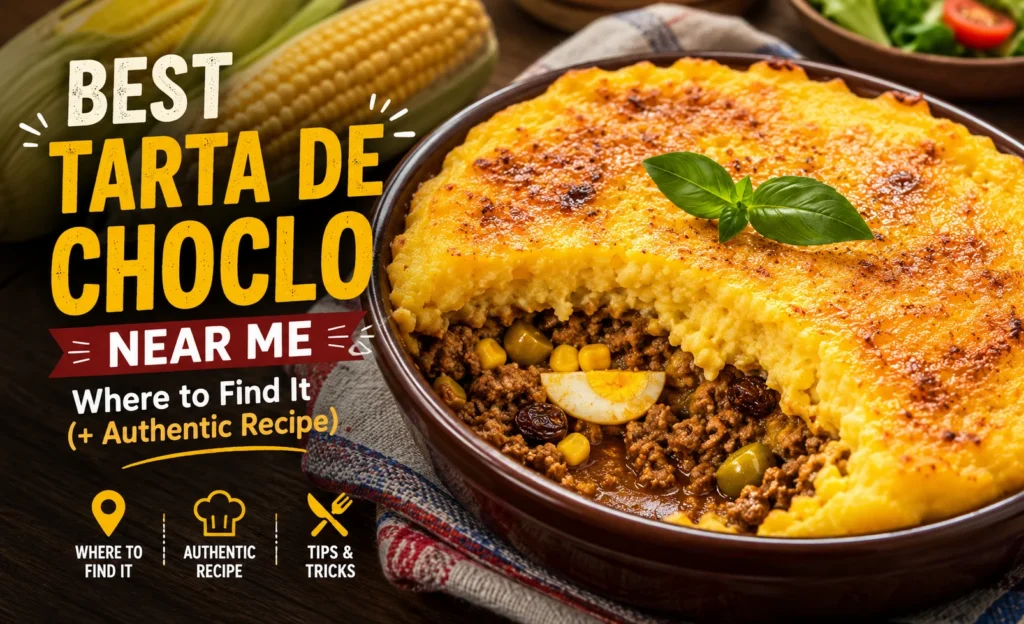

If you’ve ever scrolled past a photo of a golden, bubbling corn casserole with a sweet caramelized top and wondered what on earth it was, chances are you stumbled onto tarta de choclo — also widely known as pastel de choclo, Chile’s beloved corn pie. It’s the kind of dish that looks humble in a photo but tastes like nothing you’ve had before: a layer of savory spiced beef and onions tucked beneath a thick, custardy sweetcorn topping that bakes into a slightly crisp, sugar-dusted crust.
For home cooks in the US and UK, tarta de choclo has quietly become one of the most searched-for South American comfort foods — right up there with empanadas and ceviche. But unlike those dishes, it’s much harder to find on a restaurant menu, which is exactly why so many people end up typing “best tarta de choclo near me” into Google, only to come up short.
This guide covers both sides of that search: where you can realistically find tarta de choclo near you in the US and UK today, and — since restaurant options are still limited outside major Latin American communities — a fully authentic, tested recipe so you can make it at home whenever the craving hits.
What Is Tarta de Choclo, Exactly?
Tarta de choclo (pronounced TAR-tah deh CHO-clo) translates loosely to “corn pie” or “corn tart.” In Chile, where the dish originated, it’s almost always called pastel de choclo — “pastel” meaning pie or cake, and “choclo” being the Quechua-derived word for corn used throughout Chile and parts of South America. Both names refer to the exact same dish, so if you’re searching for one and see the other used interchangeably on menus or recipe blogs, that’s completely normal.
The dish has two main components:
- The pino — a savory base of ground beef (sometimes mixed with chicken) sautéed with onions, cumin, and paprika, and often studded with olives, raisins, and slices of hard-boiled egg. This sweet-savory combination is a signature of Chilean home cooking.
- The choclo topping — fresh corn kernels blended with milk, basil, and butter into a thick purée, poured over the meat filling and baked until it sets into a golden, custard-like layer. Right before baking, a light dusting of sugar is sprinkled on top, which caramelizes in the oven to create a delicate sweet crust.
The result is a dish that plays sweet against savory in almost every bite — something Western palates aren’t always used to, but that wins people over almost instantly once they try it.
Texture-wise, think of something between a cottage pie and a corn pudding: the bottom layer has the hearty, chunky bite of a meat filling, while the top is smooth, slightly dense, and custard-like, similar to a savory corn soufflé that’s been baked just past the point of being pourable. It’s typically served hot, straight from the baking dish, and eaten with a fork rather than sliced neatly like a traditional pie.
Why It’s Called a “Pie” Even Though It Has No Crust
One point of confusion for first-time readers is the word “pie” or “tarta” itself — there’s no pastry crust involved anywhere in the dish. The naming comes from the layered, baked-in-a-dish presentation rather than any pastry component, similar to how a shepherd’s pie has no crust either but still carries “pie” in its name. Once you know this going in, the dish makes a lot more sense on the plate.
A Dish With Deep Roots
Tarta de choclo isn’t a modern fusion invention — it’s a genuine piece of Chilean culinary history. The dish is considered part of cocina criolla chilena, or Chilean Creole cuisine, which blends Indigenous ingredients with Spanish colonial cooking techniques introduced after the 16th century.
Corn was a staple crop for Indigenous peoples across the Andes long before European contact, while the beef, olives, and dairy in the pino reflect the influence of Spanish settlers. Over generations, the two traditions merged into the layered casserole eaten across Chile today, particularly during the South American summer (December to March), when fresh corn is at its sweetest and most abundant.
In Chile, tarta de choclo isn’t a special-occasion dish reserved for holidays — it’s closer to a Tuesday-night family dinner, the kind of recipe passed down from mothers and grandmothers rather than pulled from a cookbook. That’s part of why the “authentic” version varies slightly from household to household, even though the core technique stays the same.
Also Read: Best Pasticho Venezuelan Lasagna Near Me — Restaurants, Delivery & Recipe
Tarta de Choclo Near Me: Realistic Options in the US and UK
Here’s the honest answer upfront: tarta de choclo is still a niche dish outside Chile, so it won’t show up on every corner the way tacos or pad thai might. But depending on where you live, you do have real options. Here’s how to actually find it.
1. Chilean and Pan-Latin American Restaurants
Your best bet is searching specifically for Chilean restaurants, not generic “Latin American” or “Mexican” spots, since the dish is regionally specific. Cities with larger Chilean or broader South American communities tend to have the highest odds of a menu hit, including:
- United States: Miami, New York City, Washington D.C., Los Angeles, and San Francisco all have established Chilean or Latin American dining scenes where pastel de choclo occasionally appears as a rotating or seasonal special.
- United Kingdom: London has the largest concentration of Latin American restaurants in the UK, particularly around Elephant and Castle (sometimes nicknamed “Little Latin America”) and Seven Sisters, where Chilean and Colombian eateries occasionally serve it, especially in the warmer months when corn is in season.
Because tarta de choclo is corn-dependent and best made with fresh corn, many restaurants only offer it seasonally — so a quick call ahead or checking a restaurant’s Instagram for daily specials will save you a wasted trip.
2. Latin American Grocery Stores and Delis
Some Latin American grocery stores with a prepared foods counter or attached deli will sell pastel de choclo by the tray, especially around Chilean Independence Day celebrations (Fiestas Patrias, mid-September) or during peak summer corn season. This is often an easier find than a sit-down restaurant, particularly in cities with a Hispanic or Latin American grocery presence.
3. Google Maps and Local Search Tactics
Since “tarta de choclo” and “pastel de choclo” are both valid names, search both terms when looking locally:
- “Pastel de choclo near me”
- “Chilean restaurant near me”
- “Chilean corn pie [your city]”
Filtering Google Maps results by recent reviews mentioning “corn pie” or “choclo” can also surface restaurants that don’t explicitly list the dish on their online menu but serve it as a specials-board item.
4. Order Online or Via Delivery Apps
In cities with active Latin American food delivery options, some home-based Chilean cooks and small catering businesses sell pastel de choclo through platforms like local Facebook marketplace groups, community WhatsApp groups, or niche delivery apps that specialize in home-cooked ethnic food. These are often the most authentic versions available outside of Chile, since they’re made using family recipes rather than adapted for a broader restaurant menu.
5. Make It Yourself
If none of the above pan out — which, realistically, is likely if you’re outside a major city — the most reliable way to guarantee a “best tarta de choclo near me” experience is to make it in your own kitchen. The recipe below is built to be approachable for a first-timer while staying true to the traditional method.
Authentic Tarta de Choclo Recipe (Pastel de Choclo)
This recipe makes one 9×13-inch casserole, serving about 6 people as a main dish. It uses ingredients that are easy to find in a standard US or UK supermarket, with substitutions noted where fresh Chilean corn (choclo) isn’t available.
Ingredients
For the pino (meat filling):
- 2 tablespoons vegetable oil or olive oil
- 2 medium yellow onions, finely diced
- 1 lb (450g) ground beef
- 1 teaspoon ground cumin
- 1 teaspoon sweet paprika
- 1/2 teaspoon dried oregano
- Salt and black pepper, to taste
- 1/2 cup pitted black olives
- 1/3 cup raisins
- 2 hard-boiled eggs, sliced
For the choclo topping:
- 6 cups fresh corn kernels (about 8-10 ears), or 4 (15 oz) cans of sweetcorn, well drained
- 1 cup whole milk
- 3 tablespoons unsalted butter
- 8-10 fresh basil leaves, finely chopped
- 1-2 tablespoons sugar (adjust to taste, plus more for the top)
- Salt, to taste
Step-by-Step Instructions
Step 1: Make the pino (meat filling) Heat the oil in a large skillet over medium heat. Add the diced onions and cook until soft and translucent, about 6-8 minutes. Add the ground beef, breaking it apart with a spoon, and cook until browned. Stir in the cumin, paprika, oregano, salt, and pepper. Simmer for another 5 minutes until the flavors meld, then remove from heat and set aside.
Step 2: Make the choclo topping In a food processor or blender, pulse the corn kernels until you get a coarse, slightly chunky purée — you don’t want it perfectly smooth. In a large saucepan, melt the butter over medium heat, then add the corn purée, milk, and chopped basil. Cook, stirring constantly, for 10-15 minutes until the mixture thickens to a thick porridge-like consistency. Season with salt and 1-2 tablespoons of sugar, tasting as you go. The topping should taste lightly sweet, not dessert-sweet.
Step 3: Assemble Preheat your oven to 375°F (190°C). In a 9×13-inch baking dish, spread the meat mixture evenly across the bottom. Scatter the olives, raisins, and sliced hard-boiled eggs over the top. Pour the corn mixture evenly over the meat layer, smoothing it out with a spatula so it fully covers the filling.
Step 4: Add the signature sugar crust Sprinkle a thin, even layer of sugar (about 1-2 tablespoons) over the top of the corn layer. This is what caramelizes in the oven to create the dish’s characteristic golden, slightly crisp top.
Step 5: Bake Bake uncovered for 30-35 minutes, until the top is set and beginning to turn golden brown in spots. For a more caramelized finish, switch the oven to broil for the final 2-3 minutes, watching closely so it doesn’t burn.
Step 6: Rest and serve Let the tarta de choclo rest for 10 minutes before serving — this helps the corn layer set so it slices cleanly. Serve hot, ideally with a simple Chilean tomato-onion salad (ensalada chilena) on the side to cut through the richness.
Tips for the Best Results
- Use fresh corn when possible. Frozen or canned corn works in a pinch, but fresh corn gives the topping its distinctive sweetness and texture. If using canned, drain it thoroughly to avoid a watery topping.
- Don’t skip the basil. It sounds like an unusual addition to a corn dish, but basil is essential to the traditional flavor profile and shouldn’t be swapped for another herb.
- Balance the sugar carefully. The dish should taste savory-forward with just a whisper of sweetness — not like cornbread or dessert. Start with less sugar and adjust to taste.
- Make it ahead. Tarta de choclo reheats well and can be assembled a day in advance, refrigerated, and baked just before serving.
- Freeze leftovers. This dish freezes surprisingly well. Portion it into airtight containers after baking and it will keep for up to 3 months.
Common Variations
While the beef-and-corn version above is the most classic, you’ll find regional and family variations across Chile and in diaspora communities:
- Chicken pastel de choclo — chicken thighs replace or are added alongside the beef, especially in coastal regions.
- Vegetarian pastel de choclo — the meat filling is swapped for sautéed mushrooms, lentils, or a plant-based mince.
- No-raisin version — some households leave out raisins entirely, considering them a matter of personal taste rather than tradition.
- Individual portions — smaller ramekins or clay pots (called pailas) are sometimes used for single-serving presentations, common in restaurants.
Nutritional Snapshot
Tarta de choclo is a hearty, calorie-dense dish, closer to a comfort-food casserole than a light meal — which makes sense given its role as a filling weeknight dinner in Chilean households. A typical serving (roughly one-sixth of a 9×13 dish) includes:
- A solid dose of protein from the ground beef and eggs
- Natural sugars and fiber from the corn, which also provides a good amount of potassium and vitamin C
- Moderate fat content, largely from the beef and butter used in the corn topping
- Added sugars from the caramelized crust, though only a small amount per serving
For a lighter take, the beef can be swapped for lean ground turkey, and the butter in the corn layer can be reduced by roughly half without significantly affecting the final texture. The dish also holds up well as leftovers, and some argue the flavors deepen slightly by the next day once the layers have had time to meld.
What to Serve With Tarta de Choclo
Since the dish is rich and filling on its own, sides are typically kept light and fresh:
- Ensalada chilena — a simple salad of sliced tomatoes, onions, and cilantro dressed with oil and a splash of vinegar.
- Pebre — a Chilean salsa made with tomatoes, onion, cilantro, and chili, often served as a condiment alongside grilled or baked mains.
- A crisp white wine — a Chilean Sauvignon Blanc or unoaked Chardonnay pairs particularly well, echoing the region the dish comes from.
Also Read: Cookie Puns
Frequently Asked Questions
Is tarta de choclo the same as pastel de choclo? Yes. They refer to the same traditional Chilean corn and beef casserole. “Pastel de choclo” is the far more common name, both in Chile and in English-language recipe sources, while “tarta de choclo” is used interchangeably in some regions and by some home cooks.
Is tarta de choclo sweet or savory? Both. It’s a savory dish at its core — a meat and corn casserole — but the thin sugar crust on top and the natural sweetness of the corn give it a subtle sweet note that makes it distinct from a typical savory bake.
Can I make tarta de choclo without meat? Yes, a vegetarian version using mushrooms, lentils, or plant-based ground “meat” in place of the beef works well and is common in modern home cooking, though it’s a departure from the traditional recipe.
What does choclo mean? “Choclo” is a word of Quechua origin used across Chile, Peru, Bolivia, and parts of Argentina to refer to corn, distinct from the more general Spanish word “maíz.”
Can I use frozen or canned corn instead of fresh? Yes, though fresh corn produces the best texture and sweetness. If using canned corn, drain it well before blending to avoid a watery topping; if using frozen, thaw and drain excess liquid first.
Final Thoughts
Tarta de choclo is one of those dishes that rewards a little effort with an outsized payoff — it’s comforting, unusual in the best way, and deeply tied to Chilean home cooking traditions that go back generations. While finding an authentic version at a restaurant near you may take some searching (and a bit of luck, depending on your city), making it yourself guarantees you get the real thing: a savory beef filling, a sweet corn topping, and that unmistakable caramelized crust that makes this dish so memorable.
Whether you track down a Chilean restaurant serving it as a seasonal special or bake your own tray this weekend, tarta de choclo is well worth the search.
If You Want Read More Articles Visit:> The Crackstube