
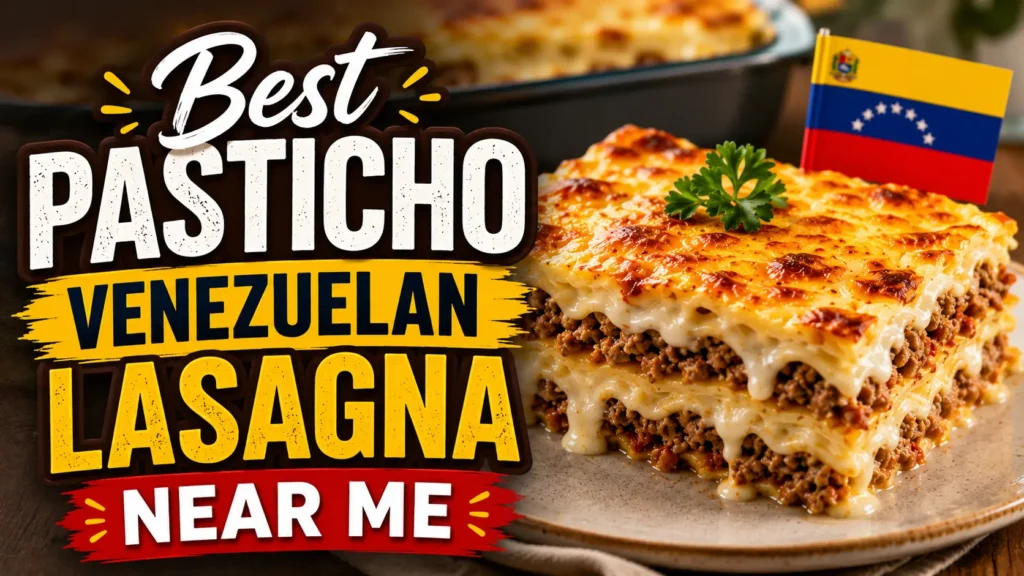

If you’ve spent any time around Venezuelan food, you’ve probably heard people rave about pasticho — often described as “Venezuelan lasagna,” though anyone who’s actually eaten it will tell you it’s a dish with its own identity. Layers of pasta, a rich cumin-spiced meat sauce, thin slices of ham, and a generous amount of silky béchamel come together into something that’s related to Italian lasagna but tastes distinctly Venezuelan.
For US and UK food lovers who’ve discovered pasticho through a Venezuelan friend, a restaurant special, or a viral recipe video, the natural next step is searching for “best pasticho near me” — and quickly realizing it’s not always easy to find outside cities with a strong Venezuelan community. This guide breaks down exactly where you can find pasticho locally, how delivery and takeout options work, and — since the dish is still rare on Western menus — a fully authentic, tested recipe so you can make it at home.
What Is Pasticho, Exactly?
Pasticho (pronounced pah-STEE-cho) is Venezuela’s take on lasagna, built on the same basic architecture — layered pasta sheets, meat sauce, and cheese — but with a few defining differences that set it apart from the Italian original:
- Béchamel instead of (or alongside) ricotta. Traditional Italian lasagna often uses ricotta or a simple tomato-cheese combination. Pasticho leans heavily on a thick, nutmeg-scented béchamel sauce layered generously between the pasta sheets, giving the dish a much creamier, richer texture.
- A cumin-forward meat sauce. The bolognese-style meat sauce in pasticho is typically seasoned with cumin, oregano, garlic, and onion powder — spices that reflect Venezuela’s own culinary identity rather than a straight Italian import.
- Thin slices of ham. Many traditional recipes include a layer of thinly sliced ham tucked between the meat sauce and béchamel, adding a salty, savory note that isn’t found in classic lasagna. Whether to include ham is something of a household tradition — some families always add it, others skip it entirely.
- A double-cheese finish. Mozzarella and parmesan are typically layered on top and between layers, melting into long, stretchy strands when the dish is cut — a textural signature that Venezuelan home cooks take pride in getting just right.
The end result is a lasagna that’s noticeably creamier and richer than its Italian cousin, with a subtle warmth from the cumin that makes it instantly recognizable to anyone who grew up eating it.
Also Read: Cookie Puns
Pasticho vs. Pastitsio: A Common Mix-Up
If you’re searching online, you may notice “pastitsio” popping up alongside “pasticho” — these are two entirely different dishes. Pastitsio is a Greek baked pasta dish, typically made with tubular pasta and a custard-like topping. Pasticho is Venezuelan, uses flat lasagna sheets, and has a completely different flavor profile built around cumin and béchamel. The names sound similar, but if you’re after Venezuelan lasagna, make sure “pasticho” (not “pastitsio”) is what you’re searching and ordering.
A Dish Born From Immigration
Pasticho’s story is really a story about migration. Throughout the 20th century, Venezuela received significant waves of Italian, Spanish, and Portuguese immigrants, particularly after World War II. Italian immigrants brought their lasagna traditions with them, and over the following decades, the dish was gradually adapted using ingredients and seasonings already common in Venezuelan kitchens — cumin, garlic powder, and the local preference for a much creamier, béchamel-heavy build.
Today, pasticho has been part of Venezuelan home cooking for well over a century, and it’s considered a staple of family gatherings, birthdays, and Sunday dinners — similar to the role lasagna plays in Italian-American households, but with a flavor profile that’s entirely its own. It’s also become something of a comfort-food symbol for Venezuelans living abroad, often one of the first dishes people recreate when trying to bring a taste of home into a new country.
Best Pasticho Near Me: Realistic Options in the US and UK
Because pasticho is a home-cooking staple rather than a dish built for restaurant menus, tracking it down locally takes a slightly different approach than searching for more mainstream Latin American dishes like tacos or empanadas. Here’s how to actually find it.
1. Venezuelan Restaurants and Bakeries (Panaderías)
Your best bet is searching specifically for Venezuelan restaurants or Venezuelan bakeries (panaderías), since pasticho is far more likely to appear there than at a general “Latin American” restaurant. Cities with sizable Venezuelan communities are your strongest leads:
- United States: South Florida (particularly Doral and Weston, both nicknamed “Doralzuela” and “Westonzuela” for their large Venezuelan populations), the greater Miami area, Houston, and parts of New Jersey and New York City all have Venezuelan bakeries and restaurants where pasticho appears as a regular or rotating menu item.
- United Kingdom: London has a small but growing Venezuelan food scene, with a handful of Venezuelan-run cafés and bakeries — often the same places known for arepas and cachapas — occasionally offering pasticho by the slice or as a weekend special.
Venezuelan bakeries in particular are worth checking, since many sell pasticho by the tray or the slice from a deli counter, alongside empanadas, tequeños, and other savory staples — often at a lower price point than a sit-down restaurant meal.
2. Search Both “Pasticho” and “Venezuelan Lasagna”
Since “pasticho” isn’t a widely known term outside Venezuelan communities, search both the native name and its English description when looking locally:
- “Pasticho near me”
- “Venezuelan lasagna near me”
- “Venezuelan bakery”
- “Venezuelan restaurant”
Cross-referencing both terms on Google Maps often surfaces more results than searching “pasticho” alone, since some restaurants list it in English on their online menus to make it easier for non-Venezuelan customers to find.
3. Community Groups and Home Cooks
In many US and UK cities, home-based Venezuelan cooks sell pasticho and other traditional dishes through Facebook groups, WhatsApp community chats, or informal weekend pop-ups, particularly around holidays or community events. These homemade versions are often the closest thing to what you’d actually be served at a Venezuelan family dinner, since they’re rarely adapted for a broader audience.
4. Delivery Apps and Frozen Options
A small but growing number of Latin American specialty grocers now stock frozen, ready-to-bake pasticho trays, particularly in areas with a strong Venezuelan or broader South American customer base. Some delivery platforms that specialize in ethnic and specialty foods also list Venezuelan bakeries that offer delivery for trays or individual portions — worth checking if a sit-down restaurant isn’t nearby.
5. Make It Yourself
If none of the above turn up results in your area — which is common outside major Venezuelan population centers — making pasticho at home is the most reliable way to enjoy an authentic version. The recipe below follows the traditional method closely, using ingredients readily available at any standard US or UK supermarket.
Also Read: Best Tarta de Choclo Near Me: Where to Find It (+ Authentic Recipe)
Authentic Pasticho Recipe (Venezuelan Lasagna)
This recipe makes one 9×13-inch pan, serving 6-8 people. It stays close to the traditional method while using ingredients you can find without a specialty grocery trip.
Ingredients
For the béchamel:
- 6 tablespoons unsalted butter
- 1/2 cup all-purpose flour
- 4 cups whole milk, warmed
- 1 teaspoon salt
- 1/2 teaspoon freshly grated nutmeg
- 1/4 teaspoon white pepper
For the meat sauce:
- 1 tablespoon vegetable oil
- 1 medium onion, finely diced
- 3 cloves garlic, minced
- 2 lbs (900g) ground beef
- 3 tablespoons tomato paste
- 1 (15 oz) can crushed or whole tomatoes
- 2 teaspoons ground cumin
- 1 tablespoon dried oregano
- 1 teaspoon garlic powder
- 1 teaspoon onion powder
- Salt and black pepper, to taste
- 1 teaspoon sugar (balances the acidity of the tomatoes)
For assembly:
- 12-15 lasagna sheets (traditional flat, not no-boil, boiled according to package instructions if needed)
- 8-10 thin slices of deli ham (optional, but traditional)
- 2 cups shredded mozzarella
- 1/2 cup grated parmesan
Step-by-Step Instructions
Step 1: Make the béchamel Melt the butter in a large saucepan over medium heat. Whisk in the flour and cook for 2-3 minutes, until golden and slightly foamy — this cooks out the raw flour taste. Slowly whisk in the warmed milk, a little at a time, to avoid lumps. Continue whisking over medium-low heat until the sauce thickens enough to coat the back of a spoon, about 10-12 minutes. Season with salt, nutmeg, and white pepper, then set aside, covering the surface directly with plastic wrap to prevent a skin from forming.
Step 2: Make the meat sauce Heat the oil in a large pot over medium heat. Add the onion and cook until soft, about 5 minutes, then add the garlic and cook for another minute. Add the ground beef, breaking it up as it browns. Stir in the tomato paste and cook for 2 minutes to deepen the flavor, then add the crushed tomatoes, cumin, oregano, garlic powder, onion powder, salt, pepper, and sugar. Simmer uncovered for 25-30 minutes, stirring occasionally, until the sauce has thickened and the flavors have melded.
Step 3: Prepare the pasta If using traditional lasagna sheets (not the no-boil variety), cook them in well-salted boiling water according to the package instructions, until just al dente. Drain and lay them flat on a lightly oiled sheet tray so they don’t stick together while you assemble the layers.
Step 4: Assemble the layers Preheat your oven to 375°F (190°C). Spread a thin layer of meat sauce across the bottom of a 9×13-inch baking dish — this prevents the pasta from sticking. Layer as follows, repeating until you run out of ingredients (typically 3-4 layers):
- A layer of lasagna sheets
- A layer of meat sauce
- A layer of ham slices (optional)
- A layer of béchamel
- A light sprinkle of mozzarella
Finish the top layer with a generous coating of béchamel, followed by the remaining mozzarella and the grated parmesan.
Step 5: Bake Cover the dish tightly with foil and bake for 30 minutes. Remove the foil and continue baking for another 15-20 minutes, until the cheese on top is melted and golden in spots.
Step 6: Rest and serve Let the pasticho rest for 10-15 minutes before slicing — this is an important step, as it allows the béchamel layers to firm up slightly so the slices hold together cleanly instead of sliding apart.
Tips for the Best Results
- Don’t rush the béchamel. A thin, under-cooked béchamel will make the whole dish watery. It should be thick enough to visibly coat a spoon before you use it.
- Season the meat sauce boldly. Cumin is what gives pasticho its distinct Venezuelan character — don’t be shy with it, and don’t substitute it with another spice.
- Let it rest before cutting. This is the single most common mistake — cutting into pasticho straight out of the oven almost always results in a messy, sliding slice.
- Make it a day ahead. Like most lasagna-style dishes, pasticho actually improves overnight in the fridge, as the layers set and the flavors continue to meld. Reheat covered in the oven at 350°F until warmed through.
- Freeze it in portions. Baked and cooled pasticho freezes well for up to 3 months — portion it into individual servings before freezing for easy reheating later.
Common Variations
- With or without ham — as mentioned earlier, this is largely a matter of family tradition rather than a strict rule.
- With peas — some regional versions, particularly from the Andean parts of Venezuela, include green peas mixed into the meat sauce.
- Pasticho de berenjena — an eggplant version where sautéed eggplant slices replace the pasta sheets entirely, popular as a lighter or gluten-free alternative.
- Chicken pasticho — shredded chicken sometimes replaces or is combined with the beef, particularly in lighter home versions.
- Extra cheese layers — some households add a layer of shredded cheese between every pasta layer rather than just on top, for an even richer, cheesier result.
Nutritional Snapshot
Pasticho is a rich, indulgent dish by design — the combination of a heavy béchamel, cheese, and a substantial meat sauce makes it closer to a special-occasion comfort food than an everyday light meal. A typical serving includes:
- A significant amount of protein from the beef, ham, and cheese
- A high fat and calorie content, largely driven by the butter and milk in the béchamel and the melted cheese layers
- Moderate carbohydrates from the pasta sheets
For a lighter version, the whole milk in the béchamel can be swapped for a lower-fat alternative, and lean ground beef or ground turkey can replace the standard beef without significantly changing the final texture.
What to Serve With Pasticho
Because pasticho is rich and filling on its own, Venezuelan households typically serve it with simple, fresh sides rather than another heavy dish:
- A green salad with a light vinaigrette to cut through the richness
- Tostones (fried green plantains) for a crispy, savory contrast
- Garlic bread on the side, though this is more of a Western pairing than a traditional Venezuelan one
Frequently Asked Questions
Is pasticho the same as lasagna?
Not exactly. Pasticho is Venezuela’s adaptation of Italian lasagna, distinguished by its heavy use of béchamel sauce, cumin-seasoned meat filling, and often a layer of thin ham slices — differences that give it a noticeably creamier texture and a distinct flavor from traditional Italian lasagna.
Is pasticho the same as pastitsio?
No. Despite the similar-sounding names, pastitsio is a Greek baked pasta dish typically made with tubular pasta and a custard topping, while pasticho is Venezuelan, made with flat lasagna sheets, béchamel, and cumin-spiced meat sauce. They are unrelated dishes from different culinary traditions.
Does pasticho always have ham in it?
No — including ham is a matter of family and regional tradition in Venezuela. Some recipes always include a layer of thin ham slices between the meat sauce and béchamel, while others leave it out entirely.
Can I make pasticho ahead of time?
Yes, and it’s actually recommended. Pasticho can be fully assembled a day in advance and refrigerated unbaked, or baked and refrigerated to reheat later — the flavors and texture often improve after resting overnight.
Where can I buy Venezuelan pasticho near me?
Venezuelan bakeries (panaderías) and restaurants in cities with a strong Venezuelan community — such as South Florida, Houston, and parts of London — are the most reliable places to find it. Searching both “pasticho” and “Venezuelan lasagna” on Google Maps will surface the widest range of local results.
What does pasticho taste like compared to Italian lasagna?
Pasticho tastes noticeably creamier and richer than a typical Italian lasagna, largely due to the generous béchamel layers, and carries a warm, earthy note from the cumin used in the meat sauce — a flavor Italian lasagna doesn’t usually have. The optional ham layer also adds a saltier, more savory dimension that sets it apart.
Final Thoughts
Pasticho sits at a fascinating crossroads of Italian technique and Venezuelan flavor, and it’s exactly the kind of dish that rewards a little searching — whether that means tracking down a Venezuelan bakery in your city or setting aside an afternoon to make it yourself. The cumin-spiced meat sauce, thick béchamel, and melty double-cheese finish make it instantly comforting, even to people trying it for the first time.
If a Venezuelan restaurant or bakery near you carries it, it’s well worth ordering. And if it doesn’t, the recipe above will get you about as close to the real thing as you can get outside a Venezuelan home kitchen.
If You Want Read More Articles Visit:> The Crackstube